
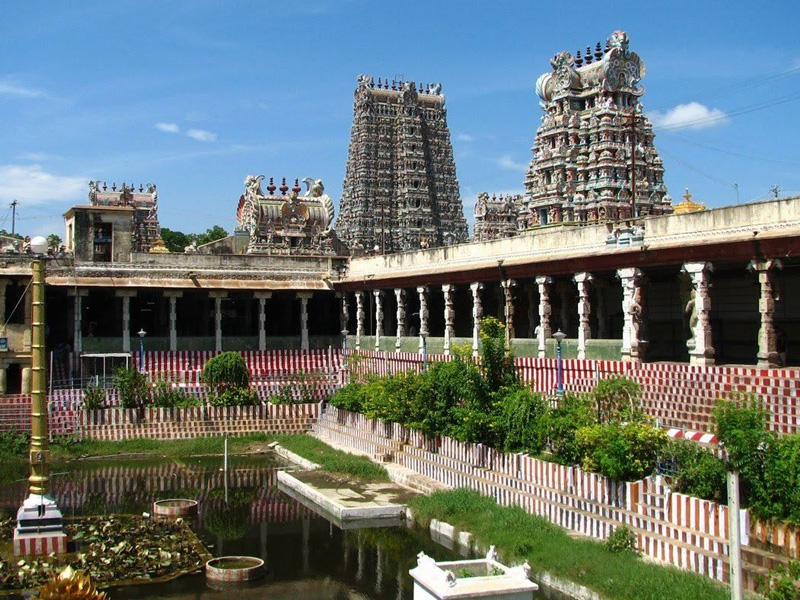
Every year, millions of devotees from across the world journey to Rameswaram to seek blessings at the sacred Sri Ramanathaswamy Temple, one of the holiest pilgrimage destinations in South India. Revered for its immense spiritual importance, the temple holds a unique place in Hindu tradition and continues to attract pilgrims, saints, and travelers alike.
This temple houses the southernmost Jyotirlinga, one of the twelve sacred Jyotirlingas of Lord Shiva found across India. While there are many Shiva Lingams worshipped throughout the country, these twelve Jyotirlingas are considered the most powerful manifestations of Shiva himself. According to Hindu belief, visiting all twelve Jyotirlingas helps free a person from suffering and the cycle of rebirth, ultimately leading to liberation.
Divine Legend of Ramanathaswamy
The presiding deity of the temple is Lord Ramanathaswamy, a form of Lord Shiva. The temple’s origin is closely connected to the epic Ramayana. After defeating Ravana, the demon king of Lanka, Lord Rama sought to absolve himself of the sin incurred by killing a Brahmin during the war.
To perform penance, Lord Rama decided to worship Lord Shiva. He requested Lord Hanuman to bring a Shiva Lingam from Kashi (Varanasi). As Hanuman was delayed, Goddess Sita created a Shiva Lingam from sand using her own hands. Lord Rama performed worship with this Lingam, which later came to be known as the Ramanathaswamy Lingam or Rama Lingam.
When Hanuman returned with the Kashi Lingam, it was named the Vishwanatha Lingam (Vishwa Lingam). Lord Rama instructed that the Vishwanatha Lingam should always be worshipped before the Ramanathaswamy Lingam—a tradition that continues to this day.
The temple complex also includes shrines for Sethu Madhava (Lord Vishnu), Goddess Lakshmi, and Goddess Vishalakshi (Parvati), whose shrine stands beside the main sanctum.
Spiritual and Architectural Significance
Rameswaram is one of the revered Char Dham pilgrimage sites of India, along with Badrinath, Dwarka, and Puri. Architecturally, the temple is a masterpiece of Dravidian design and is especially famous for its long pillared corridors, believed to be the longest temple corridors in the world, supported by nearly 4,000 intricately carved pillars.
Another unique feature of the temple is the presence of 64 sacred water bodies (Theerthas) located in and around Rameswaram Island. It is considered highly auspicious to bathe in these holy waters before entering the temple. Among them, 22 theerthas are situated within the Sri Ramanathaswamy Temple complex itself.
Temple Timings
- Morning: 5:00 AM – 1:00 PM
- Evening: 3:00 PM – 9:00 PM
Daily Pooja Schedule
- Palliyarai Deepa Aradhana – 5:00 AM
- Spadigalinga Deepa Aradhana – 5:10 AM
- Thiruvananthal Deepa Aradhana – 5:45 AM
- Vilaa Pooja – 7:00 AM
- Kalasanthi Pooja – 10:00 AM
- Uchikala Pooja – 12:00 Noon
- Sayaratchai Pooja – 6:00 PM
- Arthajama Pooja – 8:30 PM
- Palliyarai Pooja – 8:45 PM
Major Festivals
The most significant festival celebrated here is Maha Shivaratri, observed during February–March. The festival spans ten days and draws enormous crowds of devotees who participate in night-long prayers and rituals.
Another major celebration is Thirukalyanam (July–August), commemorating the divine marriage of Lord Ramanathaswamy and Goddess Vishalakshi.
Other important festivals include:
- Navaratri (September–October)
- Vasanthotsavam (May–June)
How to Reach Sri Ramanathaswamy Temple
By Air
The nearest airport is Madurai International Airport, located about 150 km from Rameswaram. From Madurai, taxis and Tamil Nadu State Transport buses are available.
By Rail
Rameswaram is well connected by train to major cities across India. The railway station is within walking distance of the temple.
By Road
Regular government and private bus services operate from major cities in Tamil Nadu. From the bus stand or railway station, the temple can be reached by foot (about 3 km) or by auto-rickshaw.