
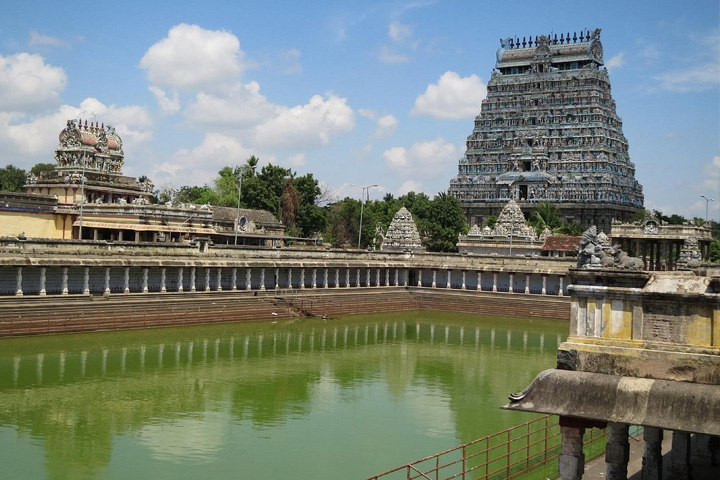
The word Chidambaram is derived from two Sanskrit terms: “Chit”, meaning consciousness, and “Ambaram”, meaning space or sky. Together, Chidambaram signifies the “Sky of Consciousness.” According to the Vedas and ancient scriptures, the ultimate purpose of human life is to attain this elevated state of awareness.
At the Thillai Nataraja Temple, Lord Shiva is worshipped as Nataraja, the cosmic dancer, eternally immersed in supreme bliss (Ananta). His divine dance, known as Ananta Tandava, represents the rhythm of creation, preservation, and dissolution that governs the universe.
One of the Pancha Bhoota Sthalams
The Thillai Nataraja Temple, located in Chidambaram town, Tamil Nadu, is one of the sacred Pancha Bhoota Sthalams—the five Shiva temples associated with the five fundamental elements of existence. This temple uniquely represents Aakasham (Ether or Space).
The five Pancha Bhoota temples are:
- Ekambareswarar Temple, Kanchipuram – Earth
- Jambukeswarar Temple, Thiruvanaikaval – Water
- Arunachaleswarar Temple, Tiruvannamalai – Fire
- Sri Kalahasteeswarar Temple, Srikalahasti – Air
- Thillai Nataraja Temple, Chidambaram – Space
Here, Shiva is revered as the formless presence that exists beyond time, matter, and dimension.
The Sacred Legend of the Cosmic Dance
Ancient legends tell of a group of sages living in the Thillai forest, who believed ritual power and mantras alone could control divine forces. To dissolve their pride, Lord Shiva appeared among them as a wandering ascetic, while Lord Vishnu accompanied him in the enchanting form of Mohini.
The sages, angered by the disruption caused among their households, performed a sacrificial ritual to unleash destructive forces against Shiva. One by one, they released fearsome entities—a tiger, a venomous serpent, a powerful demon named Muyalakan, and finally the sacrificial fire itself.
Shiva effortlessly subdued each threat:
- He slew the tiger and wore its skin
- He adorned the serpent as an ornament
- He crushed Muyalakan beneath his feet
- He held the raging fire in his hand
When the sages finally sent their sacred mantras as weapons, Shiva transformed them into anklets and began his cosmic dance, revealing that divine truth cannot be bound by rituals or magic.
Witnessing this divine act, the sages surrendered. Shiva then performed the Urdhva Tandava, a transcendental dance that sent vibrations through the universe. Lord Vishnu, who witnessed this moment, later explained its deeper meaning to Adisesha, the cosmic serpent.
Patanjali, Vyaghrapada, and the Divine Vision
Adisesha, longing to witness the cosmic dance, was instructed by Shiva to wait at Vyagrapuram. He was later reborn on Earth as Patanjali. Together with Vyaghrapada, a sage blessed with tiger-like feet, he performed intense penance at Chidambaram.
Their devotion was fulfilled on a sacred day—Poosam star in the Tamil month of Thai—when Lord Shiva manifested as Nataraja and performed the divine dance before sages, celestial beings, and gods.
Shiva and Kali at Chidambaram
Another legend speaks of Goddess Kali, the guardian of the Thillai forest, who initially opposed Shiva’s dance. Shiva challenged her to a dance duel, declaring that the loser must leave the sacred space. When Shiva performed the awe-inspiring Urdhva Tandava, Kali accepted defeat and moved to the northern side of the temple. Today, the Thillai Kali Temple stands there as a reminder of this divine event.
At the request of sages Patanjali and Vyaghrapada, Shiva agreed to remain at Chidambaram forever as Lord Nataraja, allowing all beings to witness the cosmic rhythm of existence.
Architectural and Spiritual Grandeur
The Thillai Nataraja Temple is an architectural masterpiece shaped by the Pallavas, Cholas, Pandyas, Cheras, and Vijayanagara rulers. It is considered one of the earliest and finest examples of Chola architecture.
Key architectural features include:
- Nine sacred gateways, symbolizing the nine openings of the human body
- Four grand gopurams, facing the cardinal directions
- The Shivaganga sacred tank
- The Thousand Pillared Hall, a model for later temple designs
Nearby sacred shrines include:
- Govindaraja Perumal Temple (one of the 108 Divya Desams)
- Thillai Kali Temple
The Three Forms of Worship
In the gold-roofed sanctum, Lord Shiva is worshipped in three profound manifestations:
- Nataraja – the manifested form
- Chidambara Rahasyam (Crystal Lingam) – the subtle form
- Akasha (Empty Space) – the formless, infinite reality
This rare concept symbolizes the journey from form to formless consciousness.
Major Festivals
Six Maha Abhishekams are celebrated annually in honor of Lord Nataraja:
- Margazhi Thiruvathirai (Dec–Jan)
- Masi Chaturdashi (Feb–Mar)
- Chithirai Thiruvonam (Apr–May)
- Aani Thirumanjanam (Jun–Jul)
- Aavani Chaturdashi (Aug–Sep)
- Purattasi Chaturdashi (Oct–Nov)
Another globally renowned festival is Natyanjali, held in February, where classical dancers from across India offer Bharatanatyam performances to Lord Nataraja.
How to Reach Thillai Nataraja Temple
By Air
The nearest airport is Tiruchirappalli International Airport, about 160 km away. From there, taxis and buses are available to Chidambaram.
By Rail
Chidambaram is well connected by rail, with frequent trains from major cities across India.
By Bus
Regular government and private bus services connect Chidambaram with all parts of Tamil Nadu.